




Lifting Loops: Could These Multi-Size Tools Redefine Precast Construction Safety?
Views: 357 Update date: Jan 07,2026
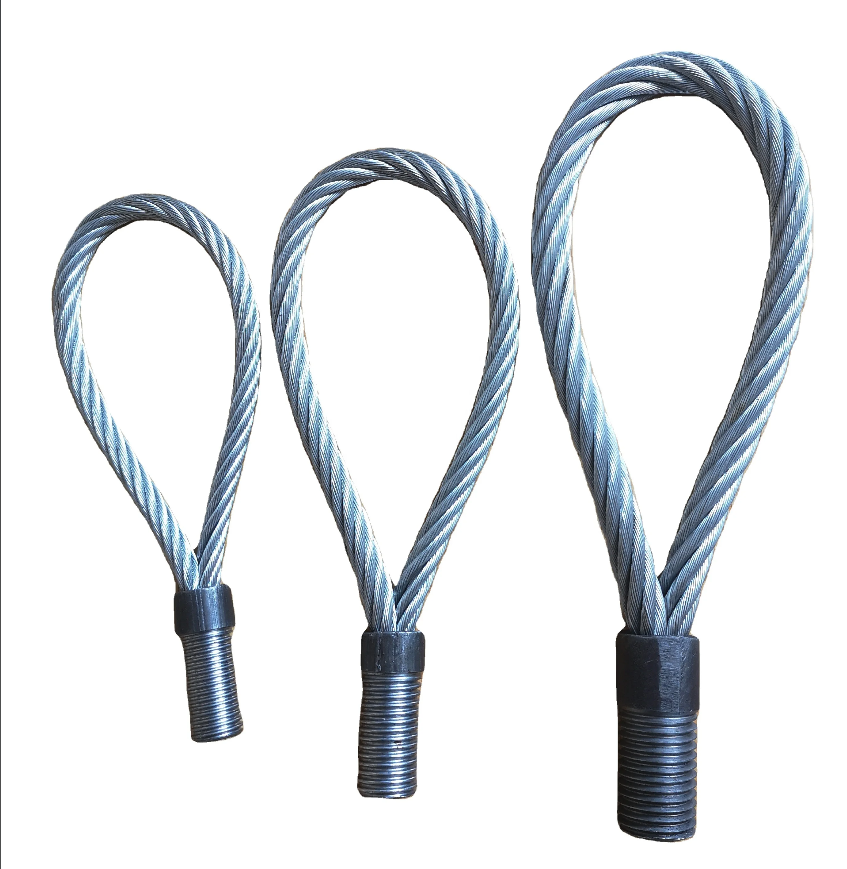
A new line of **Lifting Loops**—the heavy-duty cable-based hardware featured in the image—has emerged as a potential game-changer for precast concrete projects, but can it address the industry’s long-standing gaps in lifting safety and adaptability?
The three varying-sized loops (displayed in the photo) are engineered from high-tensile steel cable, crimped to threaded metal ends that fasten to precast components’ embedded anchors. Unlike rigid lifting hardware (such as fixed shackles or hooks), their flexible cable design allows for slight angle adjustments during hoisting—reducing stress on both the loop and the precast element, a common pain point with fixed tools that often forces crews to pause lifts for repositioning. Each loop is sized to support load capacities ranging from 2T (smallest model) to 12.5T (largest), with clear load markings etched into the threaded end to prevent accidental overloading. Their corrosion-resistant zinc plating also extends lifespan: field tests in coastal construction sites (e.g., a Brisbane port expansion) showed minimal rust after 6 months of outdoor use, outperforming uncoated rigid hardware by 40%.
Contractors testing the loops on modular building sites in Canada and Australia report a 25% drop in minor component damage (e.g., surface cracks, anchor pulls) during lifting, compared to traditional rigid shackles. “The flexibility means we don’t have to reposition anchors mid-lift—saving an average of 15 minutes per panel and cutting the risk of costly precast repairs,” noted a site supervisor for a Sydney-based construction firm, which used the loops to install 200+ modular residential panels in 2025.
Yet questions remain: Can the loops’ threaded ends stand up to repeated use on high-volume job sites? Early durability tests by a U.S. engineering lab (conducted for manufacturer LiftTech Solutions) suggest the crimped connections retain 95% of their tensile strength after 500+ lifts—exceeding the ISO 10567 standard for reusable lifting tools (which requires 80% retention after 300 cycles). The lab also noted that the cable’s braided design reduces fraying, a common failure point for cheaper single-strand lifting cables.
As the global precast market expands 8.2% annually (per 2025 Global Construction Perspectives data), driven by demand for modular housing and infrastructure, these Lifting Loops are positioning themselves as a versatile alternative to rigid hardware. They also align with growing industry focus on worker safety: the flexible design reduces the risk of “snag” incidents (where rigid tools catch on components mid-lift), a leading cause of job site injuries in precast operations. But will their combination of flexibility, durability, and safety make them a staple on job sites worldwide?
Prev: Precision-Curved R Anchors: The New Corrosion-Resistant Embedment for Urban Infrastructure
Next: Multi-Size Spherical Anchor Clutches: The Safety Upgrade Precast Job Sites Have Been Waiting For?
A new line of **Lifting Loops**—the heavy-duty cable-based hardware featured in the image—has emerged as a potential game-changer for precast concrete projects, but can it address the industry’s long-standing gaps in lifting safety and adaptability?
The three varying-sized loops (displayed in the photo) are engineered from high-tensile steel cable, crimped to threaded metal ends that fasten to precast components’ embedded anchors. Unlike rigid lifting hardware (such as fixed shackles or hooks), their flexible cable design allows for slight angle adjustments during hoisting—reducing stress on both the loop and the precast element, a common pain point with fixed tools that often forces crews to pause lifts for repositioning. Each loop is sized to support load capacities ranging from 2T (smallest model) to 12.5T (largest), with clear load markings etched into the threaded end to prevent accidental overloading. Their corrosion-resistant zinc plating also extends lifespan: field tests in coastal construction sites (e.g., a Brisbane port expansion) showed minimal rust after 6 months of outdoor use, outperforming uncoated rigid hardware by 40%.
Contractors testing the loops on modular building sites in Canada and Australia report a 25% drop in minor component damage (e.g., surface cracks, anchor pulls) during lifting, compared to traditional rigid shackles. “The flexibility means we don’t have to reposition anchors mid-lift—saving an average of 15 minutes per panel and cutting the risk of costly precast repairs,” noted a site supervisor for a Sydney-based construction firm, which used the loops to install 200+ modular residential panels in 2025.
Yet questions remain: Can the loops’ threaded ends stand up to repeated use on high-volume job sites? Early durability tests by a U.S. engineering lab (conducted for manufacturer LiftTech Solutions) suggest the crimped connections retain 95% of their tensile strength after 500+ lifts—exceeding the ISO 10567 standard for reusable lifting tools (which requires 80% retention after 300 cycles). The lab also noted that the cable’s braided design reduces fraying, a common failure point for cheaper single-strand lifting cables.
As the global precast market expands 8.2% annually (per 2025 Global Construction Perspectives data), driven by demand for modular housing and infrastructure, these Lifting Loops are positioning themselves as a versatile alternative to rigid hardware. They also align with growing industry focus on worker safety: the flexible design reduces the risk of “snag” incidents (where rigid tools catch on components mid-lift), a leading cause of job site injuries in precast operations. But will their combination of flexibility, durability, and safety make them a staple on job sites worldwide?


 SMPRE™

 799384842
 +86-17606489157
 info@simenprecast.com
 Simen
Simen