




Key Differences Between European, American and Universal Precast Concrete Accessories
Views: 306 Update date: Apr 09,2026
The precast concrete industry is a cornerstone of modern construction, with Europe and the United States leading global innovation in accessory design, manufacturing standards and application practices. While universal precast concrete accessories serve basic construction needs, European and American products stand out for their stringent engineering, material specifications and regional compliance—differences that directly impact project safety, durability and compatibility. Below is a breakdown of the core distinctions between these regional product lines and standard universal accessories.
1. Engineering Standards & Compliance
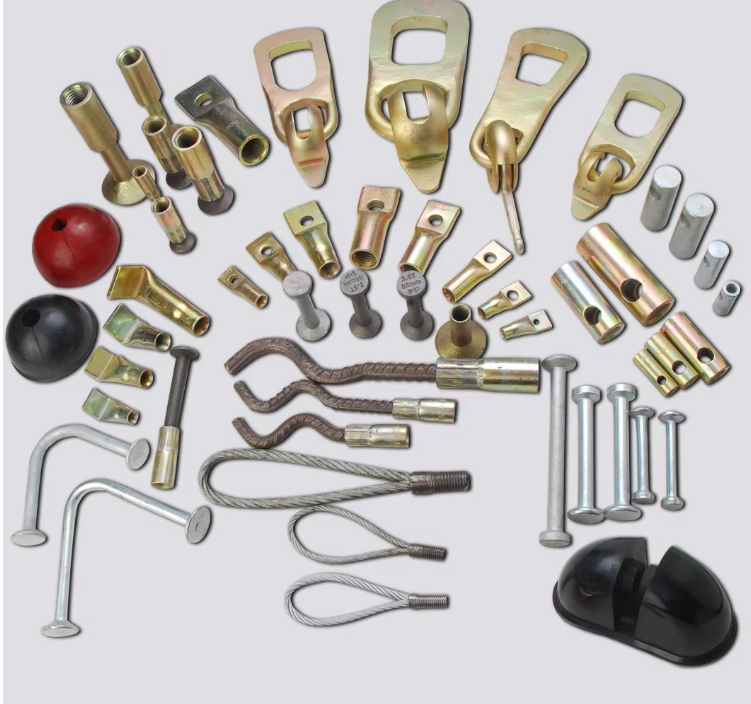
European precast concrete accessories, such as lifting anchors, fixing sockets and formwork components (like the steel connectors shown in the image), adhere to Eurocode (EN) standards—notably EN 1337-2 for lifting devices and EN 1090 for structural steel fabrication. These standards mandate rigorous load testing (e.g., minimum 2.5x safety factor for lifting accessories) and traceability of raw materials, ensuring compliance with CE marking requirements for the European Economic Area (EEA).
In contrast, American products follow ASTM International standards (e.g., ASTM A36 for carbon steel, ASTM F1554 for anchor bolts) and are often certified to PCI (Precast/Prestressed Concrete Institute) guidelines. PCI certification emphasizes performance in high-seismic zones and heavy-load applications, a critical consideration for U.S. construction projects.
Universal precast accessories, by comparison, typically meet basic industry benchmarks but lack regional certification. They are often manufactured to generic load ratings without third-party testing, making them unsuitable for large-scale or regulated projects in Europe and the U.S.
2. Material & Manufacturing Quality
European manufacturers prioritize high-grade alloy steels (e.g., S355JR) and hot-dip galvanization for corrosion resistance, especially in Northern Europe’s harsh climate. Precision machining and robotic welding are standard for components like steel connection plates (pictured), ensuring tight tolerances (±0.1mm) for seamless integration with precast molds.
American accessories often use ASTM A108 carbon steel with electro-galvanization or powder coating, balancing durability with cost efficiency for North America’s diverse construction markets. For heavy-lifting applications, U.S. producers frequently incorporate forged steel for lifting clutches and spherical anchors, enhancing tensile strength for large precast panels.
Universal accessories commonly use low-carbon steel with minimal corrosion treatment and manual welding, leading to inconsistent dimensional accuracy and shorter service life—particularly in outdoor or coastal environments.
3. Design & Application Focus
European precast accessories are engineered for modularity and sustainability. For example, lightweight aluminum formwork components and reusable plastic fixing sockets align with the EU’s green building directives (e.g., LEED Europe), reducing construction waste and carbon footprint. Steel connectors (as shown) are designed for quick assembly, supporting Europe’s precast industry’s focus on off-site manufacturing speed.
American products emphasize heavy-duty performance for large-scale projects like high-rises and infrastructure. Lifting anchors with higher load capacities (up to 50 tons) and bolted connections for seismic resistance are standard, reflecting U.S. building codes for earthquake-prone regions (e.g., California’s CBC).
Universal accessories feature a "one-size-fits-all" design, lacking the specialized engineering for regional climate, seismic activity or construction methods. They are primarily used in small-scale, residential projects where performance requirements are less stringent.
4. Supply Chain & After-Sales Support
European and American suppliers offer comprehensive technical support, including on-site installation training and custom component design for unique precast projects. Many also provide 10–20 year warranties for structural accessories, a testament to product reliability.
Universal accessory suppliers typically focus on bulk production with limited technical assistance, offering shorter lead times but no post-sale support for complex applications.
Conclusion
While universal precast concrete accessories fill a niche for low-cost, basic construction, European and American products set the gold standard for safety, quality and compliance. For international contractors and precast manufacturers, understanding these regional differences is critical to selecting the right components for project success—whether navigating Eurocode certifications for a European high-rise or PCI standards for a U.S. infrastructure project. As the global precast industry evolves, cross-regional collaboration may bridge these gaps, but regional engineering and quality will remain defining factors for years to come.
Prev: SIMEN PRECAST Unveils High-Performance Compact Anchor for Precast Concrete Construction
Next: Qingdao Simen Precast Introduces Innovative Cable-Embedded Lifting Anchors for Precast Concrete Efficiency
The precast concrete industry is a cornerstone of modern construction, with Europe and the United States leading global innovation in accessory design, manufacturing standards and application practices. While universal precast concrete accessories serve basic construction needs, European and American products stand out for their stringent engineering, material specifications and regional compliance—differences that directly impact project safety, durability and compatibility. Below is a breakdown of the core distinctions between these regional product lines and standard universal accessories.
1. Engineering Standards & Compliance
European precast concrete accessories, such as lifting anchors, fixing sockets and formwork components (like the steel connectors shown in the image), adhere to Eurocode (EN) standards—notably EN 1337-2 for lifting devices and EN 1090 for structural steel fabrication. These standards mandate rigorous load testing (e.g., minimum 2.5x safety factor for lifting accessories) and traceability of raw materials, ensuring compliance with CE marking requirements for the European Economic Area (EEA).
In contrast, American products follow ASTM International standards (e.g., ASTM A36 for carbon steel, ASTM F1554 for anchor bolts) and are often certified to PCI (Precast/Prestressed Concrete Institute) guidelines. PCI certification emphasizes performance in high-seismic zones and heavy-load applications, a critical consideration for U.S. construction projects.
Universal precast accessories, by comparison, typically meet basic industry benchmarks but lack regional certification. They are often manufactured to generic load ratings without third-party testing, making them unsuitable for large-scale or regulated projects in Europe and the U.S.
2. Material & Manufacturing Quality
European manufacturers prioritize high-grade alloy steels (e.g., S355JR) and hot-dip galvanization for corrosion resistance, especially in Northern Europe’s harsh climate. Precision machining and robotic welding are standard for components like steel connection plates (pictured), ensuring tight tolerances (±0.1mm) for seamless integration with precast molds.
American accessories often use ASTM A108 carbon steel with electro-galvanization or powder coating, balancing durability with cost efficiency for North America’s diverse construction markets. For heavy-lifting applications, U.S. producers frequently incorporate forged steel for lifting clutches and spherical anchors, enhancing tensile strength for large precast panels.
Universal accessories commonly use low-carbon steel with minimal corrosion treatment and manual welding, leading to inconsistent dimensional accuracy and shorter service life—particularly in outdoor or coastal environments.
3. Design & Application Focus
European precast accessories are engineered for modularity and sustainability. For example, lightweight aluminum formwork components and reusable plastic fixing sockets align with the EU’s green building directives (e.g., LEED Europe), reducing construction waste and carbon footprint. Steel connectors (as shown) are designed for quick assembly, supporting Europe’s precast industry’s focus on off-site manufacturing speed.
American products emphasize heavy-duty performance for large-scale projects like high-rises and infrastructure. Lifting anchors with higher load capacities (up to 50 tons) and bolted connections for seismic resistance are standard, reflecting U.S. building codes for earthquake-prone regions (e.g., California’s CBC).
Universal accessories feature a "one-size-fits-all" design, lacking the specialized engineering for regional climate, seismic activity or construction methods. They are primarily used in small-scale, residential projects where performance requirements are less stringent.
4. Supply Chain & After-Sales Support
European and American suppliers offer comprehensive technical support, including on-site installation training and custom component design for unique precast projects. Many also provide 10–20 year warranties for structural accessories, a testament to product reliability.
Universal accessory suppliers typically focus on bulk production with limited technical assistance, offering shorter lead times but no post-sale support for complex applications.
Conclusion
While universal precast concrete accessories fill a niche for low-cost, basic construction, European and American products set the gold standard for safety, quality and compliance. For international contractors and precast manufacturers, understanding these regional differences is critical to selecting the right components for project success—whether navigating Eurocode certifications for a European high-rise or PCI standards for a U.S. infrastructure project. As the global precast industry evolves, cross-regional collaboration may bridge these gaps, but regional engineering and quality will remain defining factors for years to come.


 SMPRE™

 799384842
 +86-17606489157
 info@simenprecast.com
 Simen
Simen